A journey in words...

Welcome to my journey in words! A story about health, exercise, weight loss, food addiction, humor, size discrimination, sarcasm, social commentary and all the rest that’s rattling around inside my head...

I now twit, er... or tweet. Anyway, you can follow me on twitter @Aeon1202
Showing posts with label Fighting Size Discrimination. Show all posts

Friday, March 10, 2017

Nike's Gone Plus Sized!

I found out this week that the popular athletic gear designer Nike has released a plus sized line (sizes 1X to 3X), so of course I had to check it out. Here is the link if you’d like to take a look at the goods for yourself.


I’ve previously praised Under Armor for their size inclusivity, which goes up to a 2XL (or for most women roughly sized 18-20). They also make an attractive, durable, quality product. Nike is actually taking it a few steps further as I did the math and realized that their size 3XL should fit all the way up to a 24/26, which is very impressive!

I haven’t tried out any Nike stuff yet but if/when I do, I’ve got my eye on this really nifty asymmetrical workout tank with the vented back.


As with UA, the clothes don’t come cheap. Currently there’s nothing in the line that costs less than $40.00. This, however, is typical for name brand active wear. After poking around the site I found that their straight sizes are priced comparatively so they’re not charging more for the plus gear.

I’m not surprised that Nike is doing this, in fact what surprises me more is when clothing retailers remain hesitant to tap the generous market of plus sized people ready and willing to pay them for attractive and well-made clothes. Or they’ll do so, but keep it hidden away online like a naughty secret. I’m looking at you here, Old Navy -  who makes great workout clothing in a wide variety of sizes but only sells the plus ones via website distribution rather than putting it in stores. Because plus sized people couldn’t possibly want or need to try things on first (please note my dripping sarcasm). Under Armor, much as I love them, is guilty of this too.

One nice trick I’ve learned regarding Old Navy, is that since they only sell the plus stuff online people frequently need to return it. Old Navy is willing to take it back at the brick and mortar stores, and they then place those returned items in their clearance section. So if you’re willing to dig you can not only find the plus gear there but it’s crazy marked down in price too.

The only thing that has surprised (and dismayed) me this week is the public backlash that’s broken out beneath the bridges of internet trolls since Nike’s line went on sale. Apparently they are ‘promoting’ and ‘accepting’ obesity by creating clothing for fat people to exercise in.

Actually, they’re doing just the opposite – they’re making it easier for the people who need to exercise the most to get active and feel great and confident while doing it. And feeling great and confident while doing it is likely to help them, you know, keep doing it and thus lose weight. These kinds of trolls are probably the same ones who photograph obese people working out at the gym without their consent and then post and scorn them online, saying they should stay home until they’ve made themselves less offensive looking. Obese people like me are the ones who need to be in the gym the most! Is it so hard to encourage us, or at the very least – just leave us alone to work on ourselves in peace?

I still stand by my assertion that those who attack fat people for trying to better themselves are actually fervently hoping for those fat people to stay fat. They enjoy their feeling of superiority, and wouldn’t want it taken away by somebody’s success.

Tuesday, September 13, 2016

The Head Wound

I took an online wellness evaluation today because my health insurance has changed again and the new company offers a lot of different resources for preventative care. The eval is a way of getting started and introducing yourself in the system. Of course, it gives you a score at the end.

My score, which had no doubt been climbing steadily as I input my stats about never smoking and infrequently drinking alcohol, my dedication to ingesting five servings of fruits and vegetables per day, my daily workouts (at least three per week being strenuous) – abruptly fell like a stone of course when I input my weight.

At the end it gave me an action plan for health improvements on which I am to begin immediate work: lose weight!

“Ah,” I said quietly to myself, “That course of action had never occurred to me before.” My old friends: disappointment, discouragement, frustration, and even despair settled right in. Why? Because being told yet again to lose weight by the healthcare industry feels like being told to do something that isn’t even remotely in my control. If it was, I’d have done it by now. I’ve been on a diet for 27 years.

My frustration is this: the evaluation never asked me why I was fat, and made no attempt to discover the cause of my problem. When I clicked on the link to find out ways to accomplish the desired thinness I was of course directed to a page about healthy eating and exercise. That old mantra: eat less, move more. The default assumption being that fat people are fat because we’re all unaware that a bag of Oreo cookies eaten while never leaving our sofa shouldn’t be dinner.

Contrary to popular belief, fat people aren’t actually dumb.

At no point was I asked: have you been tested for any diseases that might effect your metabolism? Or more appropriately for me: do you think you might have an eating disorder? The only nods this evaluation made to mental health at all were to ask me if I felt depressed (no) and to rate how much I like my job.

If obesity is a symptom of a problem, then why is no effort being made to discovering that problem’s cause? And why is so little help available? If someone were anemic blood tests would be performed to discover why, but the cause of someone’s fatness is like an elephant in the room. Being fat is often like having a massive head wound and the health care industry is a person standing next to you screaming, “Stop bleeding! Stop bleeding this instant or you’ll die!”

I don’t know how to stop bleeding. If I did, I’d have stopped gushing blood all over the world by now.

It just feels like more useless hoop jumping while I continue to yoyo up and down the same twenty or thirty pounds for the rest of my life, a life which is no doubt being shortened by the physical stress of aforementioned yoyo-ing.

Ah well, time to head back to the gym for another workout.


Thursday, July 7, 2016

Thank You, Target!

On the occasions when a retailer happens to give me exactly what I’ve been asking them for, I make a point of rewarding them with my business. This is why last weekend I went shopping at Target.

Lately I’ve been seeing Target swimsuit ads on TV that feature a bunch of people of different shapes and sizes having fun by the pool while wearing cute swimsuits.

These folks:


No big fuss is made over their variety of body types, they’re just a bunch of people who enjoy the beach and want to swim. Some of them are wearing a one piece, some two pieces. The cuteness of the suit is not limited by the smallness of its wearer. A bikini body appears to be a body with a bikini on it. And that’s it. To be honest the first time I noticed one of these ads I felt happy tears welling up in the back of my throat.

The larger sized ladies in these ads are just normal people who need a bathing suit to swim in, and that is precisely what I’ve been asking for from clothiers: to just feel normal. Not to have to special order everything online where I cannot try it on first, not to search in vain for my size only to find the only things in my size are made from cheap, horrifyingly ugly fabric, not to pay five or ten or twelve dollars more for a size 18 because OMG IT’S A SIZE 18 YOU HEIFER!!

To be fair, Target has failed miserably in the past. They are the retailers responsible for this Photoshop fail where they were so eager to give their slim, teenage model an impossibly narrow rib cage and enormous thigh gap that they literally mangled her:


This debacle occurred back in 2014 and I think it’s safe to say that they’ve learned from their mistakes moving forward.

So yes, last weekend Target got my business, and my sincere thanks.

Wednesday, July 6, 2016

You Just Can't Win

Last weekend I went to see the new Disney movie, Finding Dory, with a friend of mine. It was cute and funny and touching and exactly what one might expect from the sequel to Finding Nemo. Dory was the standout character from the first movie and it was a wise move to feature her in a sequel.

One of the previews we saw was for Disney’s new film Moana, the story of a Polynesian Princess. My friend and I both thought it looked cute and worth watching, and I was pleased to hear Dwayne Johnson voicing one of the characters, a demigod named Maui.

I was later dismayed to find out that a wall of complaints is already hitting the internet about this movie and it isn’t even out yet, due to Maui’s non-standard body shape.

One camp is offended that Disney is “fat shaming” all Polynesians for depicting them as looking like Maui. To be honest, I didn’t actually think Maui looked fat – just extremely dense and powerful in a cuddly sort of way. It’s true that he doesn’t particularly look like Dwayne Johnson, but it’s a voice acting part – he doesn’t need to. And why does one Polynesian character looking a certain way mean all are supposed to be seen that way? The title character Moana, also Polynesian, is a very petite size.

Maui

Moana

The other camp of complainers is whining at Disney for promoting “unhealthy lifestyles”. This always crops up and never fails to make me want to scream. Of course any glimpse of a character with a bigger body in media doing anything but focusing solely on becoming smaller is going to cause permanent damage to children. Said children will no doubt proceed immediately to their kitchens and inhale mass quantities of food if they get the slightest inkling that it’s in any way, shape, or form okay to be anything but whippet-thin. Makes perfect sense. We mustn’t allow that.

I find both of these camps of complainers to be thoroughly exhausting.

If the general public continues to be so quick to scream a multitude of complaints at every depiction of a human being that differs from cookie cutter standard then I think animators are likely to say, “to hell with it” and just go back to drawing all their characters with a waist circumference that matches that of their neck. Because that’s totally realistic and healthy.


Saturday, April 2, 2016

Ammunition to Fight Concern Trolling

Below is my current weekly workout schedule:

Monday: One mile walk on my lunch break, followed by one hour of Zumba (high-low impact cardio) in the evening.
Tuesday: One mile walk on my lunch break, followed by one hour of Zumba (high-low impact cardio) in the evening.
Wednesday: One mile walk on my lunch break, followed by a two mile walk in the evening.
Thursday: One mile walk on my lunch break, followed by one hour of Zumba (high-low impact cardio) and then another hour of Yoga in the evening.
Friday: 20-30 minutes on a cardio machine (elliptical cross trainer or treadmill) followed by 45 minutes lifting free weights. When possible, I attend fun special events at my gym on Friday evenings such as Zumba Step or Glow Yoga or take a two mile walk.
Saturday: One hour of Yoga in the morning, two to three mile walk in the afternoon.
Sunday: Two to three mile walk.

This is my training schedule under ideal circumstances. I do not always do all of it every week (for example, if it’s cold, raining, or snowing, that impacts my taking a walk outside). However I do most of it on most weeks, so about 80% of what you see up there gets done on an average week. Also, you don’t see me taking a “rest day” because at my current fitness level walks don’t really count as “workouts” per say, they’re just my body performing its normal form of locomotion. So Wednesday and Sunday where all I do is walk – those are technically rest days.

So why am I sharing this?

For one thing, I’m sharing it because I’m proud of the level of physical activity I have worked up to. Judging by every statistic I’ve ever read I get far more exercise than the average American, and that is something to be proud of. I didn’t suddenly start doing all of this on a whim, I used to just walk five or six days a week and that was it. I’ve been working up to this level for the past eight months so as to include a good variety of cardiovascular training, endurance work, balance, and strength improvement. Even so, every single day, some part of my body is always sore. I don’t consider that a bad thing.

I am not doing this to make you feel bad if you don’t do this much. I have several things going for me that allow this schedule: such as not having to care for small children, not being impeded by a physical injury or disability, not working several jobs simultaneously, or simply not wanting to. It’s a human’s perfectly natural state to want to conserve calories – before our environment became so obesogenic that trait actually kept us alive. If you don’t want to get up and do cardio every day that actually makes you perfectly normal.

And even though I have the luxury of time to do all this, things suffer as a result. My family doesn’t usually get dinner cooked for them on Mondays, Tuesdays, or Thursdays – which means I eat a lot of quick sandwiches before running to the gym and my family winds up grabbing fast food burgers way too often. Left to their own devices the two skinny dudes I live with will tend to do that.

So I work out a lot more than the average American and have been doing so for the past eight months, and this is what I currently look like:


I am not thin. I may get thinner, I’m certainly trying to, but I don’t actually know what I weigh right now because I haven’t checked in over a month. My clothes fit, so I suppose I weigh whatever I did a month ago – which I think was 230 lbs. Believe it or not, 230 lbs. when you have the eating disorder that I do is not too bad. After all, I used to weigh 295 lbs. However for the moment I don’t seem to be losing weight to any large degree, and it is what it is.

So as you go about your life, you may encounter someone who snorts derisively at a person my size and says something to the effect of, “if they’d just workout now and then they wouldn’t be fat like that”, or “if they would just get their fat butt off the sofa and take a walk every day they’d lose all that extra weight”, or “they probably have diabetes, look at the size of them!”

If you encounter someone like that (often referred to as a “concern troll” because they exhaust a great deal of mental energy being overly concerned for the health of other people based on the use of physical appearances they think are ugly as a diagnostic tool), feel free to send them to this page so I can say, “hello”.

I realize they might shrug me off as a liar – but why would I do that? I’m not claiming that I defy physics by eating barely 1,000 calories per day and working out this much and still not being thin. True my metabolism is slower than average, but I still weigh this much because I still eat enough calories to support my 230 lb. body weight. I eat very healthfully overall but I struggle against binge episodes on a daily basis and I enjoy dessert now and again. That being said the concern-troll battle cry of, “put the fast food down, fatty!” does not apply to me either. I eat a fast food meal about once every three months or so – or about three times a year, which is not enough for it to account for my weight.

In fact, according to quantifiable physical metrics such as blood pressure, blood sugar, cholesterol, triglycerides, etc. I am “healthy” – but I’d still like to take 60 more pounds off because I want my joints to last and those numbers may not stay so good as I continue to age. It’s not about appearance. An appearance that is physically attractive in the socially acceptable way would be nice, but it’s not happening. Sixty pounds down from here I’m going to look even more like a sag-bag than I do right now, and that is what it is, I’ve got to accept it. I can be healthy though, I can be strong, and I can have amazing endurance – those are attainable goals. Heck, I’ve already attained them I just want even more of them. I also have binge eating disorder and it’s not going away, so it could be a whole lot worse than it is right now and I’m genuinely proud of how far I’ve come.

Concern-trolls simply may be enlightened to know that sometimes the work a person puts in at the gym doesn’t show like they expect it to on the outside for a myriad number of complex reasons they surely cannot understand at a glance. And as always, it is impossible to judge a person’s health or even activity level by looking at them.


Monday, January 4, 2016

An Uppity Fatty Victory

Once again this year I signed up for the Wellness coaching program at work in order to get a discount on my health insurance costs. Once again they came to the office to weigh, measure, take blood pressure, and sample my plasma for cholesterol, sugar, triglycerides and the like.

Last Tuesday they called me at home to set up coaching sessions.

This company uses the word “stratify” to classify members into health categories – so when they call they will say things like, “you’re stratified as high risk for a heart attack because of your weight so we need to talk about weight loss strategies for you” or, “you’re stratified as high risk for diabetes because of your weight so we need to talk about weight loss strategies for you.” I have, in the past, referred to their monthly call to me as the fat check.

In my head their calls go something like this:
Coach: “Hi Carolyn! Are you still fat?”
Me: “Yes.”
Coach: “Oh – well try not to be fat and we’ll talk to you again next month! Do you have any questions?”
Me: “My allergies are really bad, can you help with that at all?”
Coach: “No, not really.”

I’m exaggerating of course, the conversations weren’t quite that awful. Although it is true that my request for how to deal with my allergies did baffle my coach and I had to teach her exactly what binge eating disorder is.

My time as a customer has been marked by discontent on my part. At one point I explained to them at length who invented the BMI, why he invented it, and why it should not ever be used as an indicator of patient health. I told them how unfair and prejudiced it was that they continue to stratify me as unhealthy and high risk despite my great blood work, great blood pressure, four to six workouts per week, my daily goal of a minimum five servings of fruits and vegetables, my low consumption of red meats and saturated fats, my non-smoking status, my extremely low alcohol consumption, and my continued slow weight loss.

My coach was sympathetic but firm: the BMI rules all. The BMI says “obese” so I’m still stratified unhealthy. End of story. She did ask, however, if they could follow up with me on my concerns in order to better their system, and I eagerly agreed.

I got bounced around between coaches a lot after that, and part of my brain wondered if I’d been stratified not only as unhealthy but also as an uppity fatty that nobody wanted to work with. I’m polite, but on this topic I can get pretty passionate.

Then last Tuesday’s call happened, and the conversation went like this:
Coach: “Okay Carolyn, since you’re stratified as healthy you can sign up for whatever you’d like to learn. We offer intuitive eating techniques, general nutrition, general wellness, exercise advice…”
Me: “Wait a second – did you just call me healthy?”
Coach: “Yes, you’re healthy and low risk so your sessions will be about whatever you’re interested in.”

I nearly cried. Very happy tears.

Since I still fall right on the borderline between overweight and obese on the BMI scale, this means the wellness company has changed what “healthy” looks like in their metrics. They have stopped canting the system heavily toward whatever the BMI says and started looking at the overall picture: including eating habits, workouts, blood work, lifestyle, and all the things that really matter.

They have stopped using appearance (and the beauty standard) as a diagnostic tool.

I would like to believe I had some small part in their change, and that now they can actually do some good for people instead of conducting useless monthly fat checks.

I signed up for sessions about intuitive eating, and when I asked if the coach I’d be speaking to was familiar with binge eating disorder the scheduler on the phone replied, “absolutely.”

Keep shouting! We can make things better!


Tuesday, October 20, 2015

Food Policing

Seriously. Don’t do this. Ever.

What follows is more or less a transcript of a conversation I had in my work break room this morning while I was trying to put together my morning cup of caffeine.

Me: Staring blankly into a very full refrigerator, trying to figure out where I left my little bottle of coffee creamer. A male co-worker came in (aged 50-something, generally a nice guy).

Him: Using the low, chastising tone of voice you use with your dog when you find them rooting through the kitchen trash, “get outta there.”
Me: Looking up in confusion, “excuse me?”
Him: “I said get outta there.”
Me: Further confused, “why am I not allowed to look in the fridge for my coffee creamer?”
Him: “Because that stuff is all junk.”
Me: Now angry, hurt, defensive, you name it… “well, when I desire an opinion on what I put in my body other than my own, I will be sure to come look for you.”
Him: “So in other words, shut up?”
Me: “Pretty much.”

Then, since I was hurt, angry, and defensive, I explained that my coffee creamer is fat and sugar free. Which I shouldn’t have, because it is in no way, shape or form anyone’s business other than my own what I am choosing for breakfast. He then food shamed me again because – chemicals.

He even said, “speaking as a diabetic; that artificial crap is worse for you than just eating sugar.”

Although I was feeling a strong desire to point out at that juncture that, although fat, I am not a diabetic (nor suffering from any weight-related complications) I simply took my coffee and left.

I wonder what he would have said if I hadn't identified that I was specifically looking in there for coffee creamer? His objection began when he came into the break room to find a fat girl peering into a fridge, so the fact that I was looking for food of any sort is what wasn't allowed. At my size I should be able to live comfortably off my fat stores for a few months, right? And according to him I need to do so until I stop shamefully taking up too much space.

Speaking as someone who does have an eating disorder, this kind of encounter can be incredibly harmful. Getting policed, shamed, and harassed for having the nerve to both be fat and eat in public is exactly why people retreat to eat in secret. And eating in secret is where binging occurs. I’ve struggled for years to find the courage to unapologetically eat in public – and when something like this happens it knocks me back down a peg like nobody’s business.

I reiterate, I know that intentions are good ones when this kind of conversation occurs. I know, and I don’t care.

Do. Not. Do. This. To. Anyone.

Ever.

Friday, September 11, 2015

Fat Prejudice Trumps Reason

I’m not a big fan of “reality TV”, but I enjoy shows where people are competing to make things. Shows like Jim Henson’s Creature Shop, Face Off, and Project Runway all appeal to my desire to see what talented and creative people can dream up.

I’m currently watching the 14th season of Project Runway, and my favorite contestant to win is a beautiful young woman named Ashley with enviable lavender hair and a distinct Rockabilly style.


She’s killing it so far, in only five episodes this season she’s already had the top design twice. She’s also sweet and seems pretty easy to get along with and work beside. When Tim Gunn asked the contestants to divide into two teams at the onset of episode 5, Ashley had every reason to believe she’d be chosen first.

Instead, this happened:

(The part of the show where they divide into teams begins at around 2:30.)

Even Heidi Klum is flabbergasted that this talented girl is left last, unwanted by either team.

I was saddened, but not surprised, since that pretty much summed up every event in my entire childhood that required us kids to divide into teams. It doesn’t matter if the challenge at hand is physical, mental, creative, or otherwise – if you are an unacceptable body size nobody wants you on their team, even with abundant evidence at hand of how talented and skilled you are.

People of size don’t have to prove themselves competent once, or even twice, to be granted the same benefit of doubt that average sized people are given without a second thought – they have to do it every damned day. Whatever they accomplished yesterday is instantly forgotten.

As a side note: the contestants didn’t know when they were choosing these teams that they’d be facing a physical challenge so they weren’t even flaunting their prejudice against Ashley’s presumed athletic ability but rather rejecting her on a gut instinct level. That being said, it turns out the girl is lethal with a paintball gun – so at least she got to shoot the living crap out of her detractors a short while later.

Shame on them. Every single one.

Friday, April 3, 2015

Please Don't Call Yourself "Fat"

If you are not.

Last month one of my favorite bands was on tour in Europe.  A lot of people met them, took pictures, and subsequently (and graciously) shared those pictures on social media.  The pictures were adorable and fun to see, but I lost count of how many of them came with one of the following captions:

“I look totally gross and fat, but here’s my photo.”

Or

“I look horrible and fat in this but I have to post it anyway.”

Or

“I look so fat in this pic, but here it is!”

100% of the attached photos contained a young woman of average to small size, usually quite pretty by conventional standards.

Look… I know what calling ourselves “fat” when we are quite obviously not fat is code for.  It’s coded language for, “I feel insecure about how I look because the world constantly reminds me that I’m worthless outside of being beautiful, so please please please reassure me that I am.”  And these girls inevitably got what they were looking for, a virtual tidal wave of internet assurances that they were not fat, and that they were beautiful.  I get it, believe me.  When I was younger, I did that.

Women who do this generally fall into one of two categories; they are seeking social reassurance as described above.  Or they are suffering from something called body dysmorphic disorder and actually cannot see themselves as they truly appear.  I’m not speaking to the body dysmorphic in this article, that problem is a whole other kettle of fish.  I’m speaking to the women of socially acceptable size who insist on using the word “fat” to seek reassurance of their beauty or to explain that they’re having a day where they don’t feel so good about their appearance, even though they know full well that they fall easily into the parameters for acceptable female body size.

Here is why that behavior is so harmful:

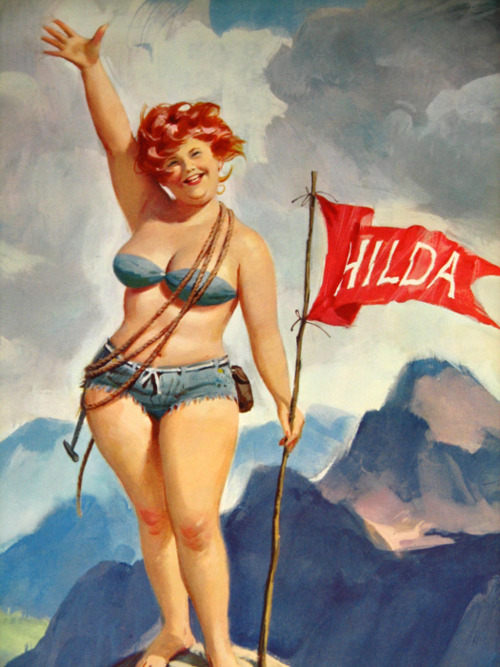
It reinforces the social standard that “fat” is synonymous with “ugly by default”.  Fat being accepted as universal shorthand for “ugly” and “undesirable” and “unwanted” means that people like me – who actually ARE fat – are reminded constantly that our innate (and largely unchangeable) body shape is utterly unacceptable.  The fact that I have and will continue to lose weight does not change that fact.  At goal I will be 170 lbs.  I will be healthy, strong, fit, and still completely, totally and unacceptably large by American female standards.  I actually aspire to look something like the gorgeous Hilda (pictured below) when I am finished, but since my natural size is quite large, once I’ve fought down well below that weight I will continue to sag and droop like a melting ice cream cone.  My body is NEVER going to be what fitness enthusiasts refer to as a “beach body”.  Fat has been and will be a descriptor that applies to me and that is not going to change.

But I’m a grown up.  Although I get hurt (sometimes to the point of tears) by the depravations of this fat hating world, I’ve got a grownup’s thick skin and ability to realize that people are trying desperately to build themselves up when they do these things – it’s got little to nothing to do with me.

What worries me more is when it starts – in childhood.  Normally sized, healthy kids screaming the word “FATSO!” at other normally sized, healthy kids.  Fat as kid-code for “yuck” and “gross” and “I just want to feel superior to you!” leads to my friend having to comfort her eight year old when she comes home crying from school because the other girls told her she was fat (and had bugs).  At eight years old that strong, outspoken, intelligent girl is already totally aware that fat is a terrible, horrible thing to be.

But what if it wasn’t?

What if saying, “Hey – do you know Carolyn?  She’s the fat girl with crazy red hair and secretary glasses over there.  Yeah, the pretty one.”

Was exactly the same as saying, “Hey – do you know Carolyn?  She’s the tall girl over there with crazy red hair and secretary glasses.  Yeah, the pretty one.”

I understand that people being the wretched things we are, if we remove the stigma from this descriptive term kids are only going to find another way to torment one another, but go ahead and call me Don Quixote because I am still going to advocate for removing the sting from fat.

One way to do that is if average sized woman would please stop using a word that simply describes my physicality, like “tall” or “short” or “fair” or “freckly” as a lazy way to say they don’t feel great about themselves today.

It’s actually totally okay to just say, “hey – you know what?  I feel really down about the way I look today.”  Since people are told constantly that the appearance of their face and body far outweighs the content of their character that is a totally natural and understandable way to feel.  I for one am happy to build a friend back up when they’re feeling beaten down.

But not one more time am I going to tell somebody who isn’t fat yet insisting to me that they are, “you’re not fat.”  Because that’s tantamount to reassuring them, “don’t worry – you don’t look like me.”  I’ve worked way too hard stitching together the tattered shreds of my own self esteem to carve and sacrifice it up for the sake of yours.

Friday, January 30, 2015

Documentary: Fat and Back - Part 2

Since I watched and reported on part one, I figured I would go the rest of the way and check out what Katie Hopkins was up to in part two of this documentary as well.  I’m sad (but unsurprised) to report that she remains an ignorant bigot when it comes to body weight.

When I first wrote about part one, an insightful friend of mine pointed out how completely meaningless her experiment is in the first place.  It takes years for bodies to adjust to the size that they are, but once they are adjusted to that size they will fight tooth and nail to stay the same.  So a body that has been slender for life (such as Katie’s) will  tend to boomerang back to its original shape just as a body that’s been overweight for years will try very hard to remain (or return to) being fat.  Most overweight people do not become overweight in two or three months, they do it over the course of years or even decades.  Additionally, since new fat cells can be formed but not removed without surgical intervention, a body that has been fat will always be prepped and ready to become fat again.  All the extra shrunken fat cells are just sitting around, waiting and ready for the slightest hint of excess fuel in the system they can latch onto and fill up with again.  This is probably why most people (95% from most studies I have read) who have lost a significant amount of weight will return to their original size within a five year period.  After that point, a body will start to acclimate to its new shape and size and supposedly it becomes easier to remain that way instead.

This is why once I've reached my goal weight my own journey will have just begun.  I will then start a new (and possibly more difficult) challenge to maintain my new size through the five year danger zone and beat the odds.  I’m planning to open a new blog at that point and call it, “The Five Year Mission”.  Mostly because I am a Star Trek geek.

I digress…

The documentarian didn't follow a restricted diet plan to lose weight, she simply ate per her average appetite and walked a few hours a day (because yeah, most of us have a few extra hours per day available to us to spend wandering our neighborhoods) as well as returning to regular running and other forms of exercise.  Unsurprisingly, her body returned to its previous shape.  She kept on an additional 11 pounds or so, which pleased her Doctor because she’d been slightly underweight to begin with.

Through it all, she continued to bash and demean fat people as well as holding them personally responsible for “making her” do this.

I find two things here primarily frustrating.  The first is the repeated assumption on the part of people like this that fat people need to be told they are fat and unacceptable.  Allow me to illuminate folks who may not be aware of this: we already know.

Having slurs screamed at us by strangers on the street, rocks, bottles, and other trash violently thrown at us from passing cars, not fitting into seats in public spaces, being unable to find clothing in our size (let alone anything flattering or pretty), being passed over for jobs and promotions based on appearance rather than skills – those things clue us in daily.  They do not inspire us to change so as to be more acceptable to the eyes of our tormentors, they inspire us only to hide and to turn to things that comfort us, which in many cases is food.  They make us feel helpless to change something that the rest of the world finds completely unacceptable and blames us for entirely.  They encourage self-hatred, depression, and despair.

Accepting ourselves as human beings worthy of love and respect is a daunting daily struggle already.  My husband deserves at least 50% of the credit for my successful changes.  You know why?  Because he loves and accepts me and finds me beautiful at any size.  He encourages me to change because it’s what I want, and ferociously defends me against the entire world if need be.  He wants me to be happy with me, and to heck with what anybody else (including himself) thinks of it.

He has loved me into success.  Love helps.  Love works.

Body shaming and fat hatred has inspired and assisted absolutely no one ever.

People who body shame and humiliate do so under the guise of being helpful, but in reality their motivation is the feeling of smug superiority they get because what is easy for them is extremely difficult for other people.  Because (here’s another news flash) people are different.  Weight bigots do not actually want fat people to be thin anyway, because if all fat people were thin they would have to find another group to demean and think themselves superior to.

The other thing that frustrates me is the tired old trope that fat people are a drain on the health care system and thin people shouldn't have to pay for their care – be it assistance to lose weight or a weight related health complication.  By this logic, people who don’t suffer from cancer shouldn't have to pay for the cancer treatments of people who do.  People who don’t have epilepsy (which Katie has) shouldn't have to pay for the health care of people who do.

If there’s evidence that moderately fat people get sick more than thin people I haven’t seen it.  I have seen compelling evidence that repeated weight loss and gain (yo-yo dieting) is extremely hard on the body to the point of being deadly, but being a consistent body weight, even if the BMI insists you’re “overweight” is statistically the healthiest thing to be.  Bodies.  Hate.  Change.

However let’s throw science out the window and assume that being overweight will make everyone who is overweight sick.  The justification for this one is then that fat people are choosing to be fat, it’s their own fault, so denying them health care (clothing/seats on buses/human dignity/etc.) is perfectly justified.

Here’s another news flash: no, the overwhelming majority of fat people are not choosing it.  They are not choosing to have an eating disorder, or to feel ravenously hungry all the damned time, or to have genetically inherited metabolisms that strive to protect them in the event of starvation conditions, or PCOS, or any of the hundreds of reasons why individual people become overweight.

Even in the event that yes, some people simply want to be fat (I will concede that a small minority of folk like that do exist), so what?  Teenagers still start smoking these days knowing full well that putting that cigarette in their mouths may lead to painful addiction and an early death.  And you know what?  If they get sick they still deserve compassion and help.  We are not a herd of antelope that leaves our slowest members behind to die when they go lame, we’re human beings.  Our self-awareness and compassion for one another is what elevates us.  But it can only elevate us if we are willing to open our eyes, let go of the base desire to feel superior because of mental and physical biology that none of us earned or chose, and rise to that occasion.

Katie Hopkins' choice was not to rise, but instead to smugly wallow like a pig in traits that she was arbitrarily born with.

What will you choose?


Tuesday, January 20, 2015

Documentary: Fat and Back - Part 1

I watched part one of TLC’s special ‘Fat and Back’ last night.  It’s a documentary where a fat-hating media personality from Britain named Katie Hopkins decides to gain and lose about fifty pounds in a few months to prove how effortless weight loss is, and how the huge number of overweight people in the United States and Britain are all simply lazy and need to put their cheese burgers down.  (Thank God someone finally pointed that out, I had NO idea I just had to put down the burger I perpetually carry around.  My work is finished!)

For the sake of your sanity, if you are sensitive to weight bigotry and unrestrained ignorance about how different bodies work differently, I do not actually recommend you watch the documentary.  However, I admit I found it fascinating.  Also, sometimes unintentionally hilarious.

This person’s opinions are nothing new.  They are also probably not going to change very much as a result of her experiment.  I've found that ignorant, bigoted people will remain inclined to stay that way whether they are racist, homophobic, intolerant of other religions, fat haters, etc.  These days I tend to ignore them rather than argue with them because I got very tired of wasting my breath.  As Ted likes to remind me: you can't teach a pig to sing, it wastes your time and annoys the pig.

The fascinating part for me is this:  I truly had no idea how extremely difficult it is for naturally slim people to put on weight.  I mean, I knew it in a vague way because I live with one.  I've watched in fascination as my husband ate like a Hobbit (a solid six meals per day, plus snacks) and never gained an ounce.  But since I never kept track of his caloric intake I truly had no idea just how much people with poor metabolisms could take in and then just dump out the next day without storing anything.

As a guideline, physicians recommend that a woman of my height and frame take in about 2,000 calories per day.  I know from personal trial and error that consuming 2,000 calories per day with my metabolism will result in a steady 1-2 pound per week weight gain.  Around 1,700 is what I need for maintenance, and weight loss occurs between 1,200 – 1,500 depending on my activity level.

In Fat and Back, Katie doubled her normal caloric intake of 2,000 calories to 4,000 – and for two solid weeks did not gain a pound.  Let me repeat that: she gained NOTHING eating 4,000 calories per day every day for two weeks.  In the end, she had to up her calorie intake to between 6,000 – 8,000 calories per day in order to put weight on.  Having never eaten that many calories a day in my life, I have to imagine it was quite a chore.  It also completely blew my mind watching her struggle with the process.  Without meaning to, she provided fascinating evidence that it is as difficult for some people to be fat as it is for others to be thin.

Sadly, Katie failed to reach much enlightenment from this experiment as of part one.  Although she did manage to understand that there is an emotional coping component to eating she had previously been unaware of, the moment when she tearfully sobs out, “I hate fat people for making me do this!” was the unintentionally hilarious part.  In between laughing my head off I commented to Ted that, “the only thing making her do this is her desire for notoriety and cash.”  I doubt any fat people were on her doorstep begging her to show them how easily they should be able to conquer their eating disorder/illness/injury/naturally occurring metabolic rate.  By and large most fat people really just want to be left alone.

She seems to have decided that all overweight people must be consuming the 6,000 or more calories per day that she had to in order to put on weight.  If that were the case I doubt many of us would be able to hold down jobs, as eating that much looks like a full time chore.  I don’t know for sure though, since I've never tried it.  Even on days when I slip up and binge, I might approach 3,000 calories maximum - but in my five years of tracking my calorie intake I've never gone higher than that.

We shall see if part two provides her with any added insights, though I expect that her body will return to its genetically predisposed slim shape as easily as mine would balloon back up to 275 if I stopped paying attention.   She may not have learned much, but she did prove the point to me that body shape; fat OR thin, is an outstandingly difficult thing to shift.  At the very least, I appreciate having seen such a graphic demonstration of that.


Monday, January 12, 2015

Body Positive Film Review - The Heat

I adore movies, and have had something of a love-hate relationship with Hollywood (Hollyweird?) for some time now.  Obsessive nerds like me will argue endlessly over the merits and flaws of our entertainment pursuits in a way that is understandably baffling to mundies, but being obsessive and a bit bonkers over the things we love is, in my opinion, what makes us nerds.

That being said it’s become more difficult over time to get me physically into a movie theatre when a film is first released.  It’s spendy to see a film in theatres, so I reserve my movie-going dollars for films with special effects that make the big screen experience worth it.  Big explosions, aliens, winged creatures, anything with “Trek” in the title, that sort of thing.

For this reason, despite being interested when it first opened, I did not see the movie The Heat until this past weekend.

To give credit where its rightfully due: The Heat is in many ways exactly the movie I’ve been asking (okay maybe yelling at and begging for) Hollywood to make for some time now.

But first, the negatives:
1)      The film has a well deserved ‘R’ rating due to profanity.  I’m not a fan of cursing, but I understand the writer’s desire to make tough, Boston cops sound like tough, Boston cops.
2)      The movie has a high level of casual, comedic (non-gory) violence.  Not quite slapstick, more like the way Lt. Riggs would bash a bad guy over the head (repeatedly) in one of the Lethal Weapon movies in order to obtain the information he was looking for.  There’s a lot of pulling firearms on people for highly unnecessary reasons.

If any of those things will bother you this is not the film for you.

Now for what they got right:
1)      I believe this is the first ever female-lead action hero with a body shape and size that is atypical from the Hollywood standard.
2)      The plot and every character in it make absolutely zero reference to the aforementioned hero’s body shape and size.  This film contains a fat character with no fat humor or angst whatsoever, and from all evidence presented the character has a positive self-image and is not dieting.

And that is exactly the thing I’ve been asking for.  Overweight characters have been in movies for almost as long as there have been movies, but their plots inevitably revolve around stereotypes regarding their body shape and size.  Some examples:
·         She’s beautiful and sexy… despite being fat.
·         She’s completely hideous… because she’s fat.
·         All fat girls are funny!
·         She’s fat so she must be freakishly strong too.
·         She’s fat so she’s desperate for sex with anyone who will have her.
·         Of course she’s trying to lose weight!
·         Of course she has bad self-esteem!
·         You think she’s just a silly fat girl but no, she’s smart and likable too!
·         She’s obsessed with food… because she’s fat.
·         She will eat any and every food available… because she’s fat.
·         She’s unhealthy by default, inherently lazy, and can’t perform physical tasks well.
·         And my personal least favorite – let’s all laugh at the fatty’s expense.

A lot of these tropes are negative, but some are positive too.  Regardless, they have one thing in common: they make characters with non-Hollywood-standard body shapes into walking plot points that revolve entirely around their non-Hollywood-standard body shapes.  They aren’t people, they’re FAT people.  This adds to the pervasive and dehumanizing cultural mentality that a fat body is abnormal, non-standard, and a thing to be reviled, ridiculed, constantly focused on, and most importantly brought under control.

Melissa McCarthy’s character in The Heat is both tough and strong, but it’s because she’s a cop, not because of her weight.  She is physically capable, ready and willing to run after a suspect, vault over a fence and climb right out the window of an offending vehicle.  Far from lagging behind slimmer characters she is portrayed throughout the movie as charging fearlessly ahead of them.  Although the bad guys do insult both her and her partner (played with nerdy gusto by the always delightful Sandra Bullock) there isn’t a single insult or joke that’s directed at her weight.    She isn’t seen eating or obsessing about food a single time, and she is portrayed as attractive to men, sought after, and not desperate for any attention.

As a comedic action hero, I’m not going to say the character is an accurate representation of a normal person, but everything abnormal about her has nothing whatsoever to do with her weight.

This movie was so funny it gave my husband a laughter-induced asthma attack.  It had an interesting plot, strong supporting cast, and the chemistry between McCarthy and Bullock was really fantastic.  If you enjoy humorous buddy/cop films like Beverly Hills Cop, Lethal Weapon and Rush Hour, you will like The Heat.


Friday, November 14, 2014

Packing on the Pounds

Think about that phrase for a moment.  What does it do to you?  Does some part of you inwardly cringe when you hear it?  When it’s applied to a person, what do you think of that person?

I really dislike the phrase, “pack on the pounds.”

It crops up often in news media.  Gossip magazines will squeal with delight over celebrities who have gained a little weight, possibly because they’ve had a baby or some other silly little life altering event, screaming out headlines like: “so-and-so is visibly fatter, they’ve really packed on the pounds!”

The other place I frequently notice it buried is in articles about the obesity “epidemic” or how life changes and the passage of time can cause our body weight to increase.  For example articles that say things like, “women over 40 can really pack on the pounds,” or, “after women get married, they really let themselves go and pack on the pounds.”

The phrase itself brings to mind something I used to do on the beach as a child.  I would sit in the sand and pack it all around me until my legs and the lower half of my body was encased in it.  Then if I’d struck water in one of the holes I had dug, I’d make dribble castles all over my thighs.  I did this because the sand felt cool and good and because it was fun – I was packing on the sand all around myself.

Here’s why I have a problem with it in regards to weight gain: “packing on the pounds” implies an intentional, deliberate action.  I was deliberately packing sand around my body because it was fun, and using the phrase with regards to weight says that the person doing it is trying as hard as they can to gain as much weight as they can.  It brings to mind mental images of people gleefully grabbing up globby, greasy handfuls of fat and smacking them onto their own thighs and stomach in an effort to see just how big they can intentionally make themselves.

With very few exceptions, people don’t gain weight on purpose.  Most of us don’t even fully realize when it’s happening.

I got up to 290 lbs. very gradually over the course of thirty-some years.  Even though I’ve been suffering from binge eating disorder since I was around twelve or thirteen (I think it began around the time I began my first calorie restrictive dieting effort) I have never put on weight very quickly.

Since I journal everything I eat I now have a good working knowledge of how many calories a lot of foods contain, but I believe that most people do not.  A single tablespoon of butter or mayonnaise contains 100.  A tablespoon of olive oil is 120.  On top of that, when someone is eyeballing a portion instead of measuring, they don’t really have a clear understanding of just how small a tablespoon or even a cup of something actually is.  It is not difficult to gain weight in a culture of convenience food and vehicular travel, and you don’t have to be a lazy glutton to make it happen. A few high energy food choices or a single cup of full fat hot chocolate a day is more than adequate to do the trick.

Pervasive and negative language choices like this are another facet that I believe contributes to fat hatred and bias in the United States.  Much like my previous post about the way overweight actors are used and portrayed, this is another subtle negativity that works its insidious way into people’s brains.  It teaches us to see a fat stranger or even a friend who’s gained some weight and automatically think, “woah – they’ve really packed on the pounds!”

It implies deliberate self-neglect, a slovenly nature, and lack of care for personal health that is in most cases both unfair and untrue.