A journey in words...

Welcome to my journey in words! A story about health, exercise, weight loss, food addiction, humor, size discrimination, sarcasm, social commentary and all the rest that’s rattling around inside my head...

I now twit, er... or tweet. Anyway, you can follow me on twitter @Aeon1202

Monday, January 7, 2019

Are You Okay?


I was recently reading this blog post by The Happy Talent about why people need to stop asking other people, “are you okay?” and I’ve come to the conclusion that I agree with her.

In fact, it forced me to acknowledge that this comes up pretty often for me. I don’t know precisely why, though I have some guesses. I am naturally extremely pale, which our tan-loving culture associates with being ill. I don’t wear makeup on most days, and a woman without makeup is often accused of looking tired. When I’m thinking hard or imagining something (which is often) my distracted expression looks like concern. And although I’m not shy like I was as a kid, I am on the quiet and introverted side.

For these reasons, I get asked if I’m okay a lot.

My default response is to immediately grin and give an enthusiastic, “I’m great – how are you?”

Essentially, I treat it exactly the same as though I’d been casually asked how I was doing.

Which puts the person who asked in the uncomfortable position of having to admit that they thought I looked pale/tired/concerned or was being too quiet and unsmiling. Since they don’t want to admit any of those things, they simply respond that they’re okay too, and everyone moves on.
It’s amusing at times to watch people flounder over my response, but also every time someone asks me, “are you okay?” I don’t feel cared for, instead I feel thrown off balance and slightly bummed out about my appearance. I immediately think, crap – do I look that bad today? What’s wrong with the way I look today? I thought I looked okay. Crappity crap crap crap. It’s a reminder that I’m too pale, that I’m stubbornly not wearing socially approved female cosmetic enhancements, that I’m overweight, and that I’m no longer a fresh faced twenty-something.

I would much prefer a sincere, “hey, how are you today?” That question is a polite invitation to share how I’m doing, or not share as per my preference. “Are you okay?” on the other hand is a completely unsolicited, out-of-the-blue opinion that someone thinks something is wrong with me or about me, or that I look wrong in some way. And if you think about it, that’s really rude.

I completely understand and appreciate that people’s hearts are in the right place, and that they are asking because they care. I truly appreciate it – I’m just saying there’s better ways in which to care that don’t put little dents in people’s self esteem. It’s hard enough to get through a day feeling anything approaching reasonable positivity about the way we look without unsolicited query-comments implying that we don’t look so great.

The only time I think, “are you okay?” is appropriate is if you actually see someone do something that might produce an injury, like falling down, obviously limping, or smacking their head. This is a query for the obviously wounded, not for a woman who looks pale or happens not to be smiling at present.

I don’t have a problem asking for assistance if I am ill, injured, or experiencing emotional turmoil. And even if I did, “hey, how are you today?” is enough caring invitation to get me to tell you, if you’re who I wish to share any of those things with.


Wednesday, August 22, 2018

Mistaken Identity


Something unpleasant keeps happening to me, more than once. In fact, it’s happened four times now.

I keep being mistaken for someone older than I really am. And by older, I don’t mean a little bit older – I keep being mistaken for someone retirement aged, 70+ years old.

Look, I know the reality of my situation visually, I’ve lost and regained and lost and regained weight so many times that parts of my body do look like they’ve been through a war (they kind of have). And I’m not young, I’m 43. I’m not old either, I’m an age in-betweenie. I always thought I looked okay though, at least that my face looked okay.

I don’t want these mistaken identity situations to hurt me, but they do. They really, really do.

The first time was at my niece’s senior photo shoot for college. She was in her early 20’s at the time. She and my sister were working with a great photographer and since the site they were shooting at was close to my house I walked over to watch. As I walked up, the photographer smiled at me and said, “you must be Grammy.”

Grammy is what my niece calls my mom. He thought I was my niece’s grandmother.

I quickly did the math in my head. If he thought I was my older sister’s mom and my sister is in her late 40’s, then this guy was thinking I was about 70 years old. So I was apparently looking about thirty years older than I really am.

The second incident involved a nice lady at my church inquiring as to whether my friend who I’d brought to church that day was my son. My friend is 52 years old. Again, quickly doing the math, this means she thought I was at least 72 years old. Not to mention it would take a truly miraculous feat of time travel for me to be the mother of someone a decade older than myself.

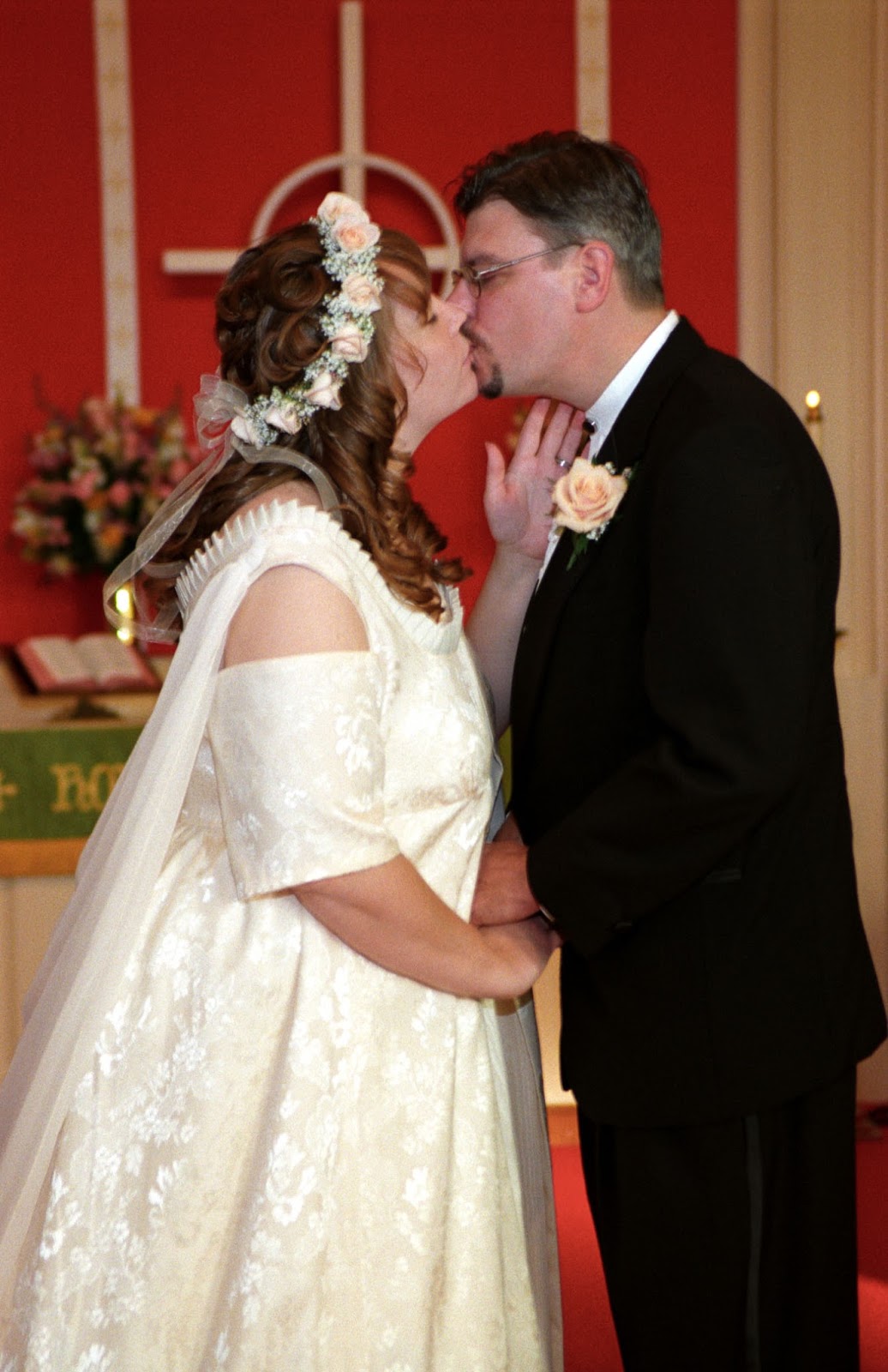
The third time was when my husband and I were out celebrating our 15th wedding anniversary and my husband mentioned this to the staff as we were seated. Our waiter came bouncing up to us and exclaimed, “I heard you’re celebrating your 50th wedding anniversary – congrats!”

So… Ted and I got married when he was 9 and I was negative 8 years old, apparently.

Or, he mistook us for a retirement aged couple, both at least 70 years of age.

And most recently I was having breakfast with a friend who was visiting from out of town. The young busboy, who knows my husband and I from seeing us every weekend, came over and asked us if my friend was my daughter. She’s 40, and once again – I’m 43.

Yes, it hurts. If it only happened once it would be one thing, but it keeps happening, over, and over, and over again. I know I need to accept that aging is inevitable, and I do, I just wasn’t quite expecting to have to accept looking retirement aged while still in my early 40’s.


Thursday, October 26, 2017

15th Wedding Anniversary

"I didn't fall in love with you.

I walked into love with you, with my eyes wide open, 
choosing to take every step along the way.

I do believe in fate and destiny, but I also believe we are only 
fated to do the things that we'd choose anyway.

And I'd choose you; in a hundred lifetimes, in a hundred worlds, 
in any version of reality, I'd find you and I'd choose you."

From The Chaos of Stars by Kiersten White


Wednesday, August 30, 2017

Political Disillusionment


I don’t often talk politics. I’ll sometimes mention a social issue on my blog, but I never repost or speak about political opinions on social media feeds.

This isn’t because I don’t have them.

It’s because I don’t like to complain about something I can’t do anything about, and I don’t believe that reposting or writing angry political stuff on social media actually improves the world at all.

At best, it’s an echo chamber – because most likely the people you’re friends with on social media all think the same way as you, so you’re all pretty much just shouting, “Yeah! Yeah! Yeah!” back and forth at each other. The people in charge are probably not monitoring our news feeds to find out what they should do next.

At worst, it turns into a fruitless, pointless, ugly fight – one in which everyone walks away angry and unsatisfied and no minds and hearts are changed. It’s not that hearts and minds cannot change, because with open, honest discussion between people who are currently sitting in the same place and looking one another in the eye it is entirely possible, but I have never (not once) seen it happen via social media, so I won’t waste my time.

Then there’s the fact that my political opinions are pretty depressing. I could bash the President, sure, he’s certainly an easy target with the way he constantly (and pointlessly) mouths off like an idiot via social media, but why bother? At the last election I practically went into the voting booth crying because I couldn’t decide which option was worse than the next – I felt they were all universally horrible. So yes, I could say, “Trump is horrible!” except that I genuinely thought the other choices were every bit as bad in different ways. So by shouting about his badness I feel like I’m saying I wish one of the other candidates had won – and that’s not how I feel. How I feel is that I desperately wish there had been sane and reasonable choices available. There were not, so I went in there knowing that regardless of who won America had already lost.

During the last election I also considered the choice to disenfranchise myself, and that’s a terrible choice I couldn’t make either. I had to go into that voting booth because I couldn’t dishonor the sacrifices of the men and women who struggled, fought, and even died to give me that right.

But how does it honor their memory when the only choices I have lie between different types of monsters?

For monsters, my friends, is all we’ve got.

I’ve officially lost faith, all faith, in our politicians. I trust none of them. I believe in none of them. I dislike all of them. America rose fast, and now it falls just as fast. I believe deeply in our system of democracy, I believe that it is good, but the political ruling class that has developed and is currently infesting it like a horde of termites is not good, they are all quite bad. Frequently I believe they are evil, and I do not know how to get rid of them.

Being angry on social media isn’t going to do it. Neither is this blog. But this is my space on the internet to talk about how I feel, even if how I feel right now is pretty damn hopeless.

Wednesday, August 23, 2017

The Cough Trope

In pondering the many differences between real life and life as it’s portrayed on movies and TV, I’ve noted a particularly amusing trope about death. (Death is always good for a laugh – right?)

In real life, when someone develops a cough, even a brutally persistent and obnoxiously wracking one that hangs on nagging for months on end – it usually means that they have something like bronchitis or asthma. Although they’re sick, in time they’ll usually be fine again. In movies and TV, if a character lifts a hand to their mouth to cough (usually delicately) it means that their death is imminent almost 100% of the time. If the creators of said movies and TV really want to drive the point home, the character in question will go so far as to cough, then look at the hand they used to cover their mouth and find it flecked with blood. At this point, picturing the Grim Reaper himself standing at that character’s shoulder is entirely appropriate, for they are a-goner.

This is one of many storytelling shortcuts that TV and movie writers use to send a signal to the audience. That signal is: cough = beware, this character will die soon. It’s effective I suppose, but a little lazy and definitely unrealistic. I sometimes wonder if getting signals like cough = imminent death drilled into our heads by our entertainment viewing contributes at times to medical anxiety and the tendency to assume that every little thing that goes wrong with our bodies, like a cold with a cough for example, is going to kill us.

A friend of mine who recently battled cancer was particularly exhausted by TV and movie writer’s frequent use of ‘the cancer card’. It’s a quick and easy way to kill off a sympathetic character in a way that will make your audience emotional – but as an actual cancer battler my friend found it very annoying. The realities of the disease were a lot more complicated than what we see up on screen, and the constant use of cancer as a way to kill characters ignores the fact that a lot of people beat cancer and survive. Seeing character after character (after character) die from it can be pretty depressing to those who are fighting to live.

As a storyteller myself, noticing these often used chestnuts is a good way to avoid using them. They say that every story has already been told, and those of us still telling them are just rearranging them in our own unique ways. I think that’s true to some degree, but avoiding over utilized tropes is one way I keep my rearrangements as fresh as possible.